What Sales Gets That Field Marketing Never Had

Julieta Raimonda
What Sales Gets That Field Marketing Never Had
8:23
A sales rep preparing for a discovery call has a Salesforce record with full interaction history. They have LinkedIn Sales Navigator. They have a battle card from the competitive intelligence team. If the deal is significant enough, they have a dedicated sales engineer who has already reviewed the account. They have a deep intelligence profile covering the executive’s organizational priorities, communication preferences, tech stack, budget cycle, and active initiatives.
They know who they are talking to before they pick up the phone.
A field marketing manager preparing for an executive dinner for 40 people has a spreadsheet. They built the guest list: they researched, curated, and invited those 40 people. They know the titles and the companies. They have LinkedIn profiles for the ones they had time to look up. What they do not have is depth: what each executive is focused on right now, what is driving their decisions this quarter, what question will move them from polite conversation to genuine interest. They have a badge scanner they hope will export correctly. They have six weeks of planning and no intelligence infrastructure that connects to any of it.
They walk into the room hoping.
Sales enablement is a $3 to $4 billion industry built around a single premise: a sales professional needs to know who they are talking to before they talk to them. That premise is treated as obvious. The investment in making it true has been continuous for two decades. CRM platforms, sales intelligence tools, battle card systems, intelligence profile generation: all of it built to close the gap between who the rep is and who the buyer is before the first word is spoken.
Field marketing has never had the equivalent.
Most field marketing teams have improvised their own versions of this. A field marketer who spends the week before an event manually researching every confirmed attendee, pulling LinkedIn profiles, piecing together CRM notes for the sales team: that person is solving the right problem. They are also spending 20 hours on work that should take 20 minutes. Manual research is not the answer. It is evidence that the answer was never built.
The asymmetry is more consequential in cybersecurity than in almost any other vertical.
A CISO receives more than 100 vendor outreach messages per week. The ones that land are not from people with the best subject lines. They come from people who have done the work of understanding what this specific executive is dealing with right now. What the current compliance environment means for their organization. Whether they are in a vendor evaluation cycle. What their team is focused on this quarter. Cold outreach does not reach CISOs. Knowledge does.
Field marketing in enterprise cybersecurity is the primary relationship-building vehicle in the entire go-to-market stack. It is where introductions happen. Where a name in a database becomes someone who takes a call. Where trust gets built at the pace that enterprise deals require. The event floor is where cybersecurity relationships start.
And yet the people running those events operate with less intelligence support than a mid-level SDR.
That asymmetry is not random. B2B sales is approximately 66% male. In B2B tech specifically, women hold fewer than one in four sales roles. Field marketing runs 60 to 75% female. For two decades, the industry invested in intelligence infrastructure for one function and spreadsheets for the other. We do not think that correlation is the cause. We do think it is worth naming directly.
There is a connection here to the Women in SPAM conversation we have been having this year. The recognition problem for women in field marketing is partly about attribution and partly about culture. It is also about this: the male-dominated function in the go-to-market team got the tooling. The female-dominated function got the workaround. When budget allocation comes around, and someone asks for ROI evidence, the channels with built-in intelligence infrastructure can answer. Field marketing reconstructs the answer manually, from memory, using tools that were never designed to support that case.
The SPAM movement named the recognition deficit. The intelligence asymmetry is one of its structural causes.
Here is what the gap looks like on the ground.
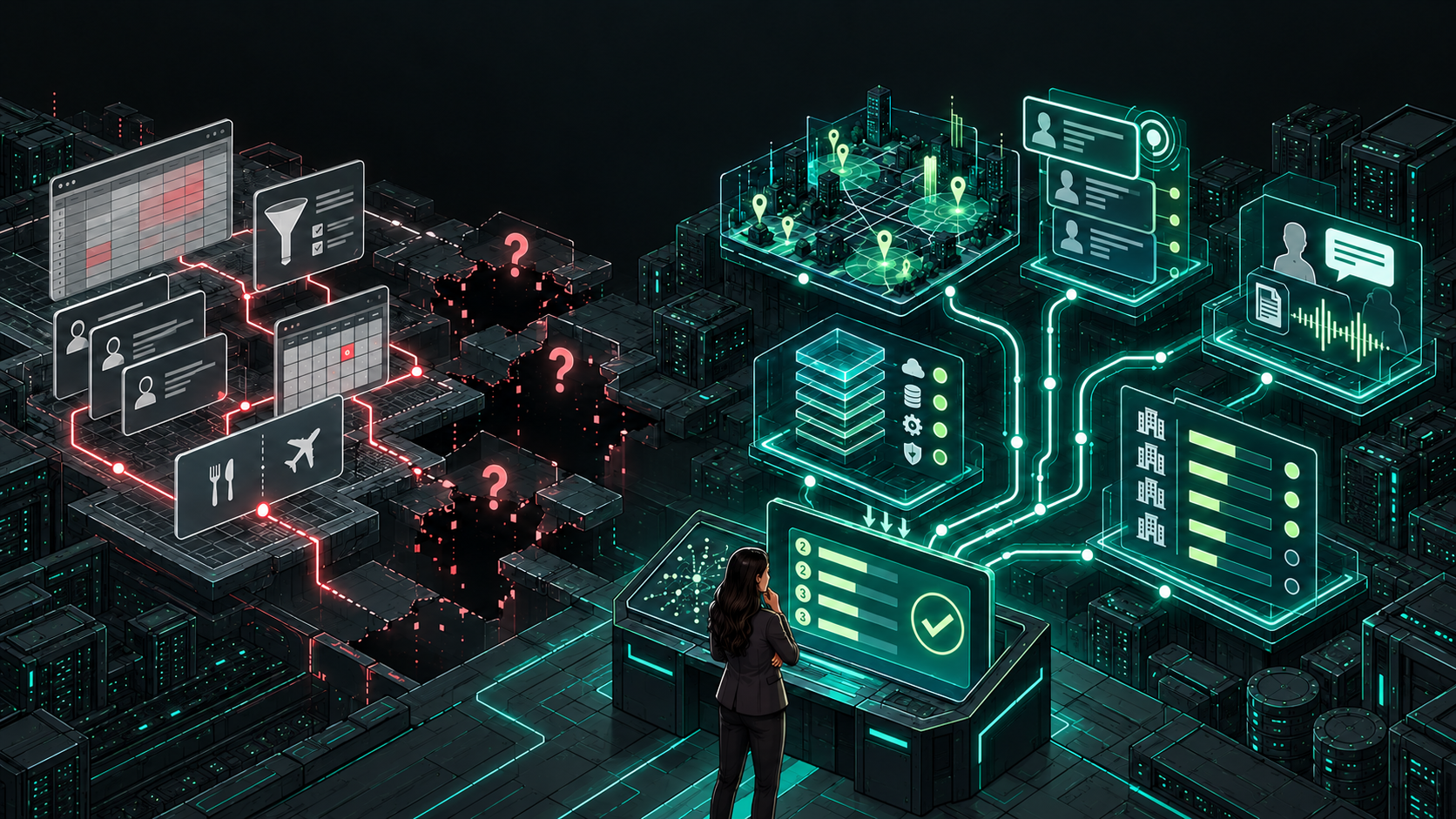
Two field marketers. Same role. Same event format. One has a full intelligence profile on every confirmed attendee before the event floor opens. One has a spreadsheet and a LinkedIn tab she kept open since Tuesday.
The first field marketer designed the guest list based on the data. She knows which attendees are six months into a platform migration. She knows who is managing active compliance deadlines. She knows who is evaluating vendors this quarter and who just renewed a contract, taking them off the table for 12 months. She built the room with that knowledge. Every rep walking in has been briefed. Every conversation has a starting point.
The second field marketer built a strong guest list from her network and the CRM. She knows the titles. She knows some of the companies. She put real work into the invite strategy. On the night of the event, she watches her best rep spend 20 minutes at dinner, realizing the executive across from him just renewed with a competitor last month. The conversation goes nowhere. The night is a waste. It is not what it could have been.
The difference between those two events is not effort. It is information.
Here is what changes when field marketing has what sales have always had.
The event design changes before a single invite goes out. When a field marketer can identify every CISO within a 50-mile radius of her venue, she is not building a guest list from a CRM export. She is designing a room. She selects based on organizational priority, current initiatives, and relationship stage. The invite list stops being a volume exercise. It becomes a selection.
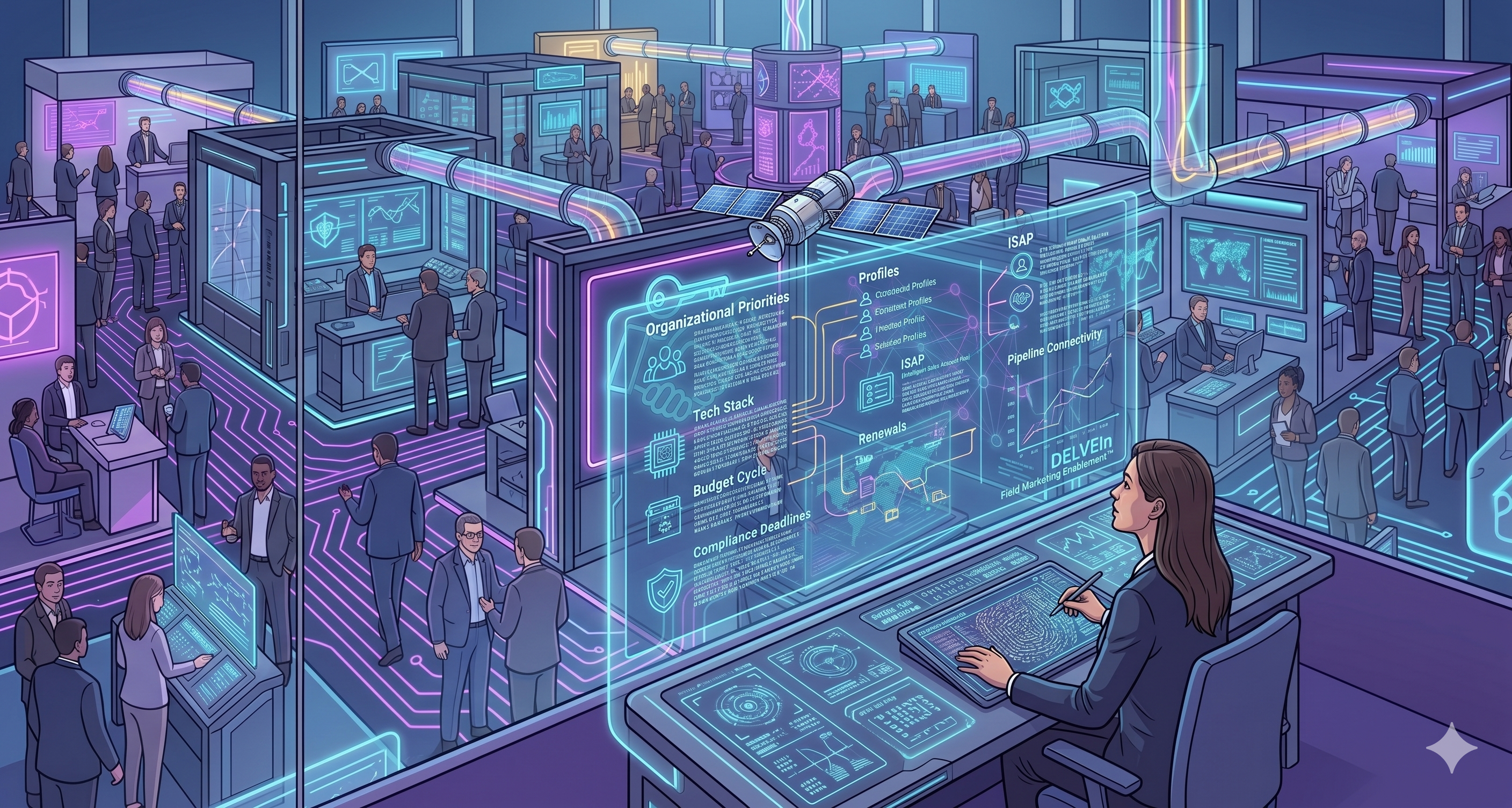
The conversations change because the preparation changes. When every confirmed attendee has an Intelligent Sales Account Plan (ISAP) before the event floor opens, the rep walking in is not guessing. An ISAP is a deep intelligence profile: the executive’s communication style, organizational priorities, active initiatives, and the specific questions that move this particular person from vendor mode to peer conversation. The rep does not spend the first twenty minutes of a dinner figuring out who she is talking to. She already knows.
The follow-up changes because the handoff changes. When the sales team receives not just names but context: what each attendee engaged with, which conversations ran long, and which contacts flagged an active initiative. The follow-up is the next step in a relationship that field marketing started. Not a thank-you note to a stranger.
And six months later, attribution runs, and the event appears. Because the infrastructure that captured who was in the room is the same infrastructure that connects attendance to pipeline.
This is what Field Marketing Enablement™ by DELVEin offers. Not manual research the night before an event. The intelligence as infrastructure from the moment the event design begins. CISO targeting by geography. ISAPs for every confirmed attendee. Lead capture standardized at the point of contact. Context that travels with the record from the event floor into the CRM and into the pipeline report.
The intelligence asymmetry between sales and field marketing has existed for a long time. It is what the women running these programs have been compensating for, manually, in conference hotels, with spreadsheets that do not connect to the pipeline.
Sales should not be the only function in a go-to-market team that walks into a room prepared. The person who designed the room, built the guest list, and created the conditions for every conversation that follows deserves the same intelligence the rest of the team has taken for granted for twenty years.
If your team is ready, delverisk.com is where to start.